1436 vues
18 Dec 2025
The recovery and coordination phases of backstroke are what transform individual movements into a seamless, rhythmic flow. Because the arms move in constant opposition—one pulling while the other recovers—timing is everything. These drills focus on the "cleanness" of the arm's exit and entry, ensuring the recovery is relaxed and the hand enters the water in a position of strength. By practicing drills like "L-Drill" and "Opposition Freestyle," swimmers develop the synchronization between the hip roll and the arm cycle, creating a balanced stroke that maintains constant momentum.
- Backstroke Recovery Alignment – This focuses on the thumb-first exit and pinkie-first entry. Swimmers learn to keep the arm straight and relaxed during the recovery, ensuring the hand enters directly above the shoulder to avoid "crossing over" or creating unnecessary drag.
- The L-Drill – This coordination exercise pauses the arms when one is at the vertical "peak" of recovery and the other is mid-pull (forming an 'L' shape). It reinforces the concept of "opposition," teaching the swimmer that the power of the underwater pull must be perfectly timed with the weightless movement of the recovery arm.
- Opposition Backstroke – This drill focuses on the "180-degree" relationship between the arms. Swimmers practice ensuring that as one hand enters the water, the other is finishing its push at the hip. This constant motion eliminates the "dead spots" in the stroke where a swimmer might lose speed.
- Hips-to-Shoulder Integration – Similar to the "Corkscrew" but focused on timing, this teaches the swimmer to use the snap of the hip roll to initiate the arm recovery. By driving the shoulder out of the water with the hip, the arm recovery becomes effortless and the entire stroke gains leverage.
Backstroke Swimming : - Arm Stroke Drill
Swim Drill - 33 - One Arm Pull/Push
THE PURPOSE OF THIS DRILL
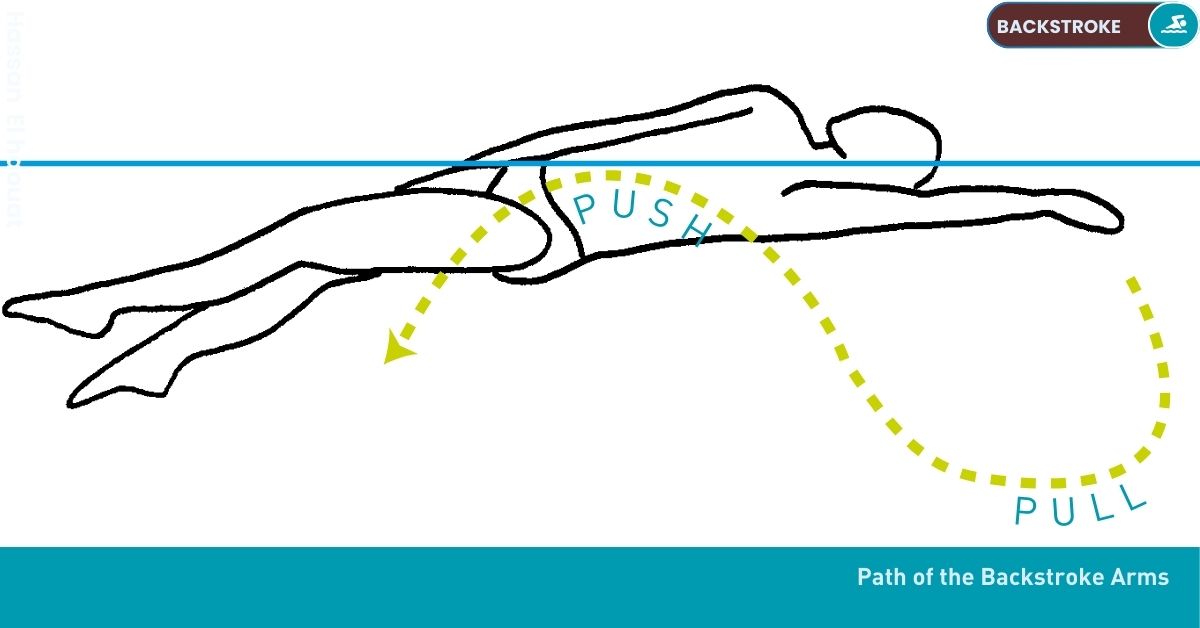
- Learning the path of the backstroke arms
- Feeling both pull and push
- Rolling into and out of each stroke
HOW TO DO THIS DRILL
- Step 1: Float in the water, face up, spine straight, good water-line, kicking productively, with one arm at your side and the other extended over your head, aligned with the shoulder.
- Step 2: Start your stroke by descending your reaching hand about twelve inches straight down into the water, pinkie finger first, allowing the opposite shoulder and hip to rise at the same time. From twelve inches deep, keeping your elbow absolutely still, begin to move your fingertips and palm upward to press the water toward your feet. Sweep your hand to the height of your shoulder, so that your arm is close to a right angle. Done correctly, it should feel like your forearm is rotating around your elbow. This is the pull portion of the backstroke arms.
- Step 3: From that point, straighten your arm in a quick sweep until your hand stops below your hip, with your fingertips pointing toward your feet. Allow your whole arm to become involved in this sweep. At the same time, roll your same side hip upward to assist in the power of this action. This is the push portion of the backstroke arms.
- Step 4: Recover your arm over the water and repeat the path of the backstroke arm with the same arm. Notice that your hand is tracing a sort of "S" shape along the side of your body. The top curve is the pull, the bottom curve is the push. This "S" shape can become more pronounced as you increase your roll into the top curve with your shoulder and hip, and out of the bottom curve with your shoulder and hip. Continue to the end of the pool.
- Step 5: Repeat the drill, quickening your tempo, and accelerating your hand toward your hip. Hold your elbow firm. Roll in and roll out of each stroke. Try to identify the transition between pull and push. Continue for several lengths, then switch arms.

Backstroke Swimming : - Arm Stroke Drill
Swim Drill - 34 - Up and Over
THE PURPOSE OF THIS DRILL
- Feeling the path of the backstroke arms
- Maintaining a stable elbow position
- Catching deep water
HOW TO DO THIS DRILL
- Step 1: Push off the wall for the backstroke, both arms extended over your head. Achieve a straight spine, firm core and good water-line. Establish a productive kick. Begin the backstroke arm stroke with your right arm, leaving your left arm in the extended position.
- Step 2: Lower your right hand about twelve inches down into the water by rolling the same side shoulder and hip down, and the opposite shoulder and hip up. As your hand reaches its deepest point, catch a handful of water. Maintaining a stable elbow position, move your handful of water in an arch up and over your elbow.
- Step 3: At the highest point in the arch, your fingers should be pointing upward toward the surface of the water, but not breaking the surface. At the finish of the arch, your arm should be straight along the side of your body, and your fingertips should be pointing toward your feet.
- Step 4: As your right arm exits the water by your hip and returns over the water to its starting position, trace the same path with your left arm. Roll your left hip and shoulder down into the water, causing your left hand to come to a depth of about twelve inches. Grab hold of deep water, and sweep your hand up and over your still elbow in an arch that finishes with your arm straight at your side.
- Step 5: Continue stroking with alternating arms. Catch the water deep and keep hold it as your hand traces an arch up and over your elbow with each stroke. Trace the arch with more speed. Feel your body move forward with each stroke. Practice for several lengths of the pool.

Backstroke Swimming : - Arm Stroke Drill
Swim Drill - 35 - Fist Backstroke
THE PURPOSE OF THIS DRILL
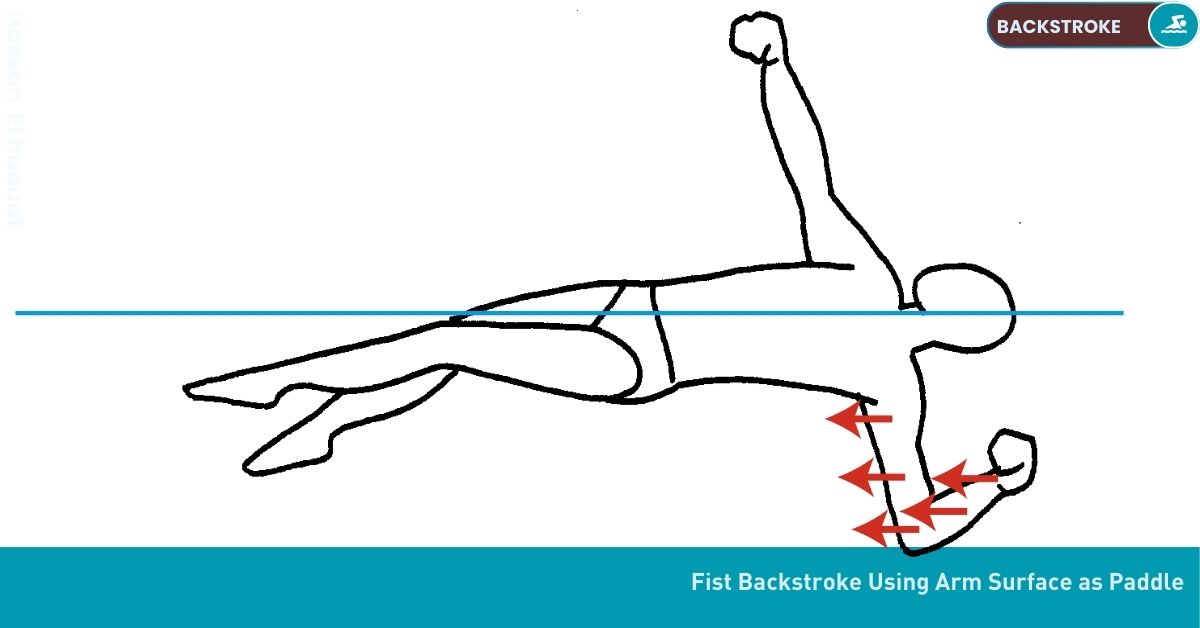
- Learning to feel the water with the forearm
- Using a stable, high elbow
- Appreciating the role of the hand
HOW TO DO THIS DRILL
- Step 1: Push off the wall for the backstroke. Before the first stroke, form closed fists with each hand.
- Step 2: Start to stroke. At first it may seem impossible to make forward progress without the paddle of your open hand. Keep stroking, purposely positioning your arm so your forearm works as your paddle to press against the water. This will require you to initiate the stroke by moving your fists without moving your elbows, and to keep your elbows high and stable as your fist moves past them.
- Step 3: Use the whole length of the stroke, top to bottom. Feel pull and push. Accelerate the underwater stroke. Maintain opposition. Adapt your stroke to the handless paddle. Continue to the other end of the pool.
- Step 4: Now push off again, this time with open hands. Swim regular backstroke, using your hand as well as your forearm to press against the water. Keep a stable, elbow high. Feel pull and push. Accelerate your stroke. Maintain opposition.
- Step 5: Continue alternating lengths of fist and open hand until you are feeling the water with a paddle that includes both your hand and your forearm.

Backstroke Swimming : - Arm Stroke Drill
Swim Drill - 36 - Corkscrew
THE PURPOSE OF THIS DRILL
- Achieving depth to begin the stroke
- Feeling the roll that begins the arm stroke
- Using a bent arm mid-pull similar to freestyle
HOW TO DO THIS DRILL
- Step 1: Push off the wall for the backstroke with your arms extended. Achieve a straight spine and good water-line. Kick productively.
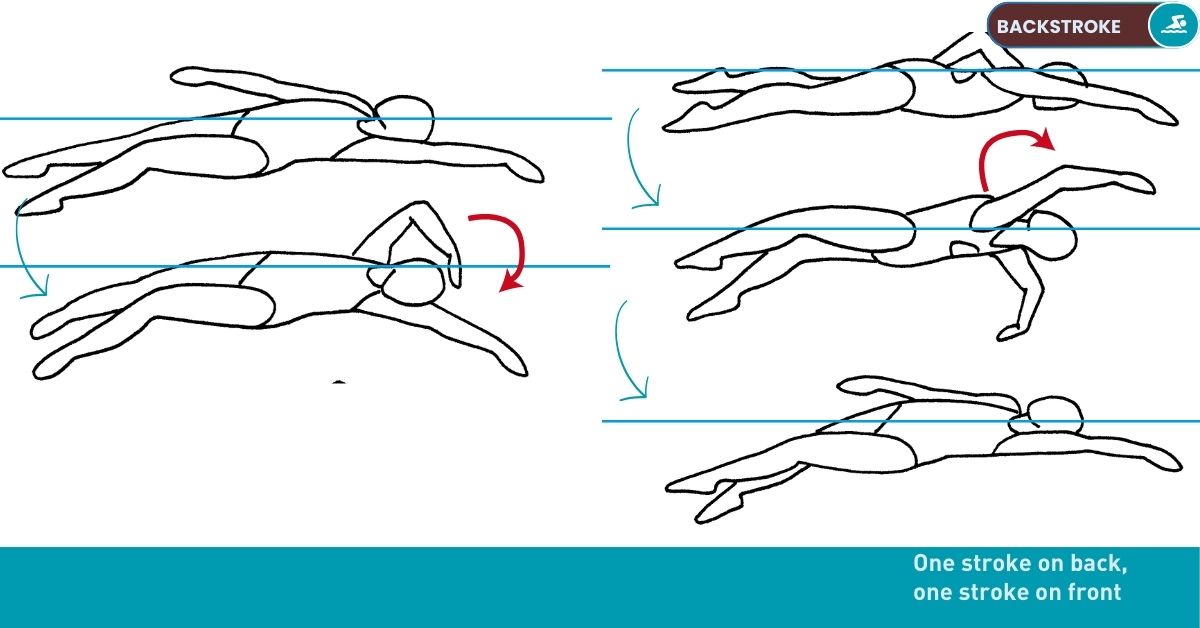
- Step 2: Take one stroke with your left arm. As your left arm reaches your side, begin to stroke with your right arm while your left arm starts its recovery over the water.
- Step 3: When your right arm approaches mid-recovery, your left arm should have come to its deepest point underwater. The shoulder and hip of your recovering arm should be at least partially out of the water, and the shoulder and hip of your stroking arm should be low in the water.
- Step 4: At this point, redirect your recovery to cross over toward your opposite shoulder, and lead your body to switch from its side, to a front floating position. Your recovering hand should enter the water as a freestyle stroke.
- Step 5: Start to stroke with freestyle as the arm at your side starts to recover as freestyle. You should again be floating on your side, and by mid-recovery, redirect your over-the-water-arm to enter the water as the backstroke.
- Step 6: Continue to move through the water, one stroke as backstroke and the next as freestyle. Feel the depth that your arm achieves to begin each stroke on your back. Notice the similar bent elbow position of your arms in both strokes during the mid-pull. Feel how rolling toward your stroking arm accesses more power for the stroke.


Catégorie:
Swimming
Publié le:
18 December 2025
Nombre de vues:
1436
Auteur:
Med H EL HAOUAT
Mise à jour:
07/09/2026